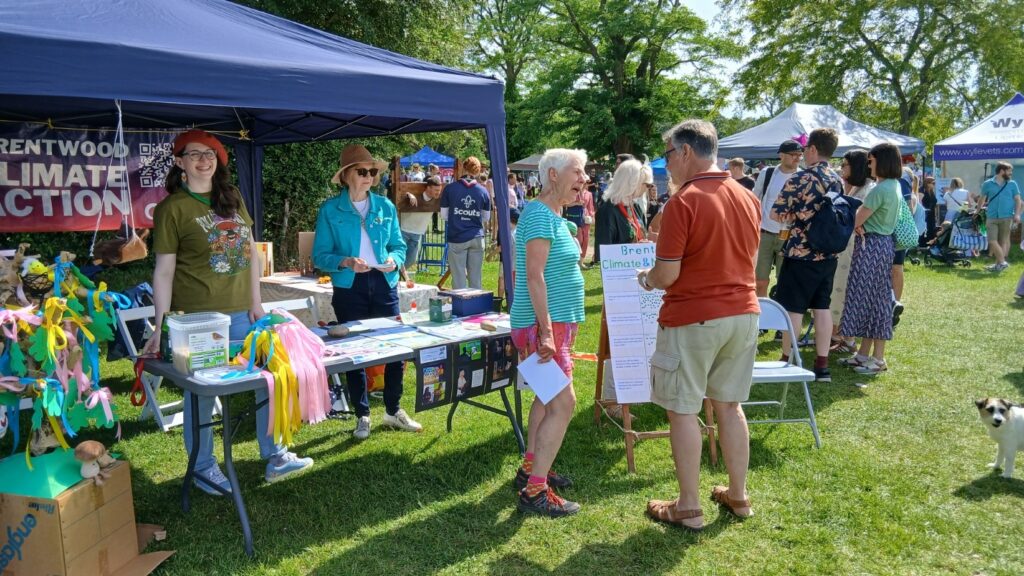
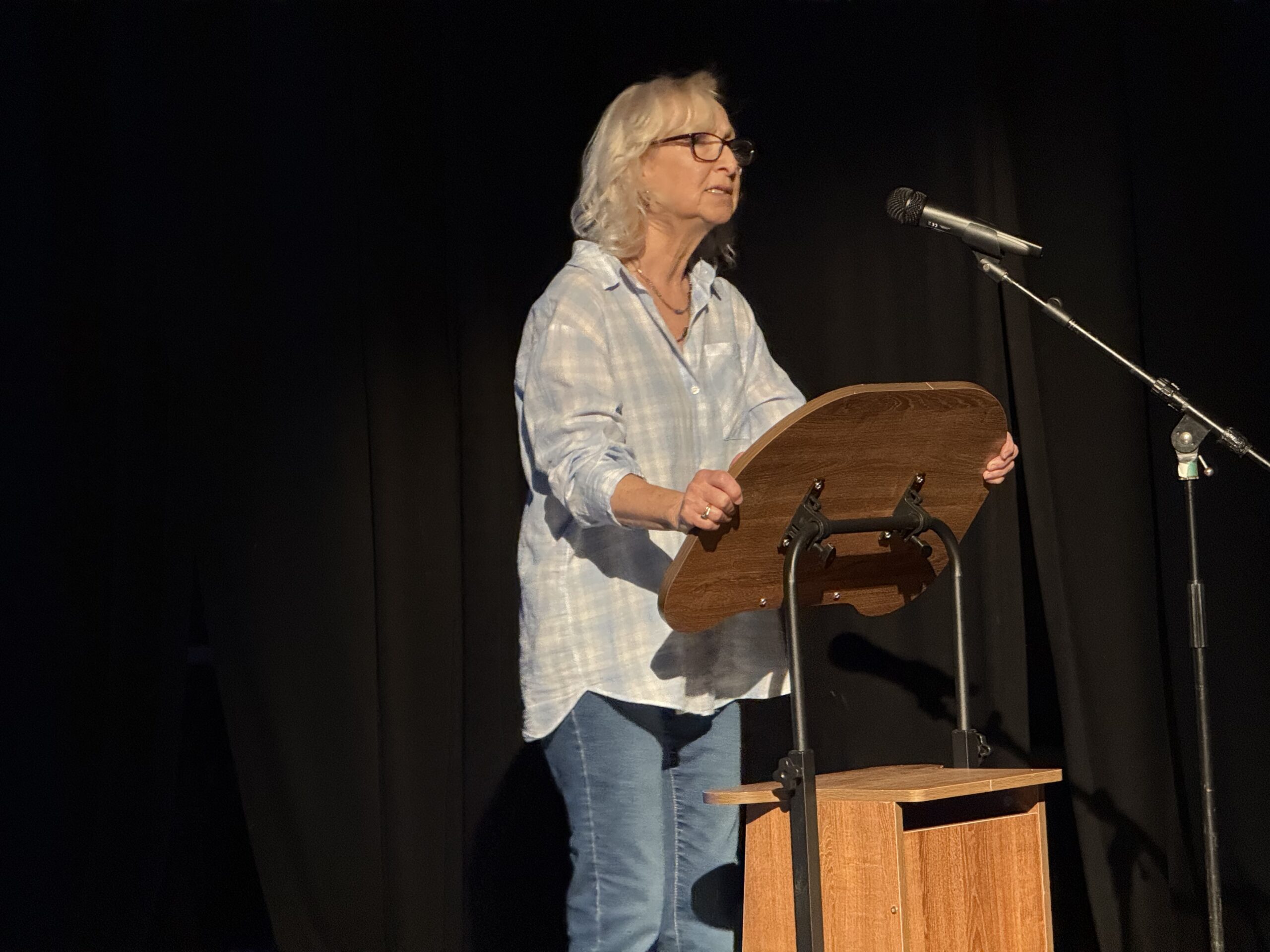
On a glorious sunny afternoon in June the BCA took part in Brentwood’s annual Strawberry Fair. There were hundreds of people in attendance throughout the day, of which many came to see us at our stall.
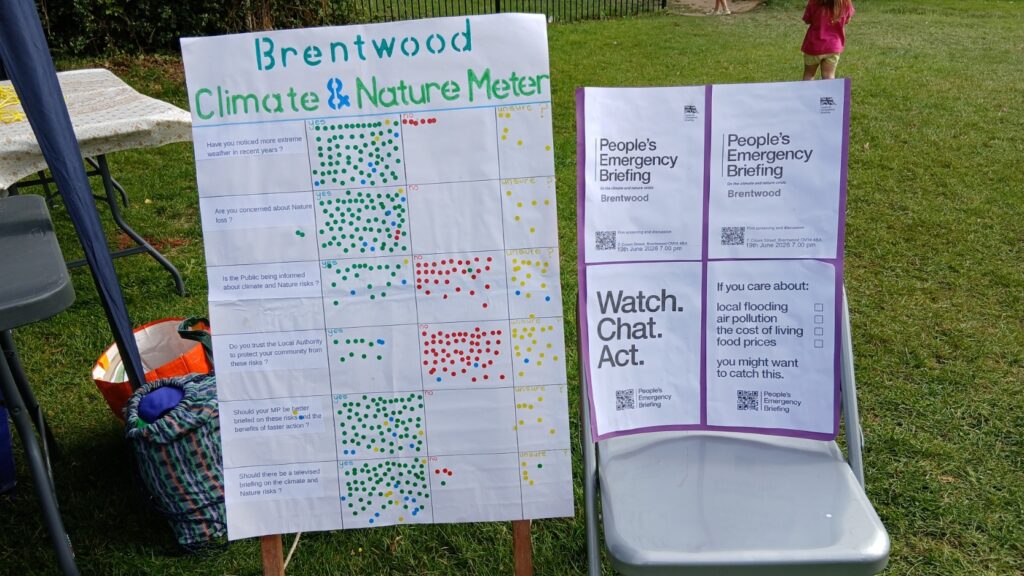
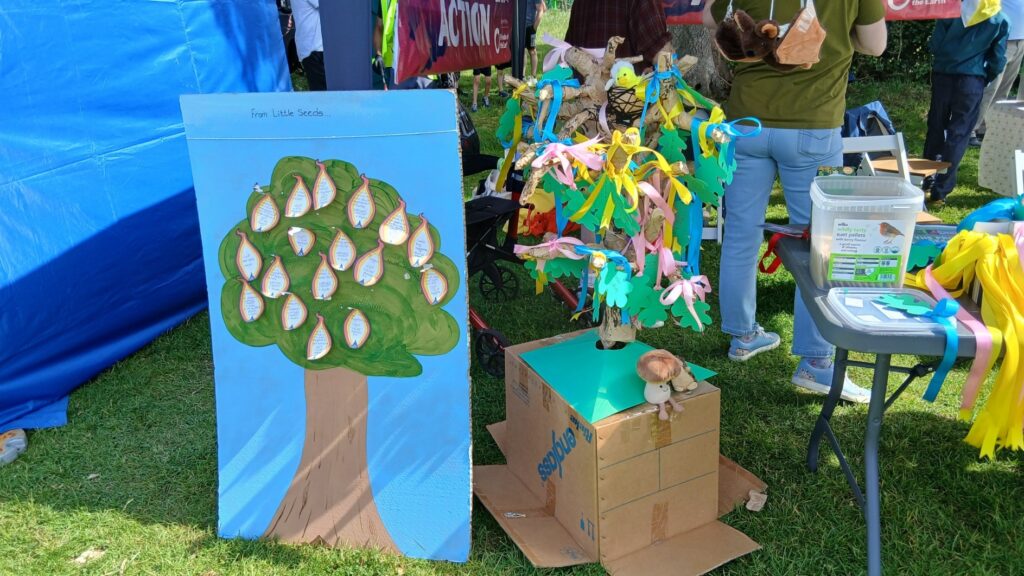
This year we had plenty of activities on offer. These included a Tree of Pledges, a Climate Meter, a Puppet Show and a free recipe for a chemical-free easy Toilet Cleaner (which had been tried and well tested by its author!)
We attracted many visitors, both young and old, to engage in thinking about their place and roles within the wider context of climate change and to help them decide in what areas or activities they could change within their own lives and/or communities.
As an organisation, it was very heartening to see that many children of all ages had, through education, a solid notion of what climate change is, of what it means and what as individuals, we can do about it.
Overall, we welcomed seven new members. The Tree amounted to 62 pledges to help the environment. The Climate Meter attracted 82 respondents. The Puppet Show ran twice, each to an audience of interested children and to finish, countless families will have spotless toilets without harming the climate, flora or fauna. Job Done! I would say!
The Climate Meter
The Tree of Pledges
The BCA stall
The BCA would like to thank all those who helped out, volunteering their time, expertise and skills on what was a very successful engagement with the wider public and the issues that we stand up for. We hope that we have managed to get many people to think about the Climate Crises, and what it truly means.
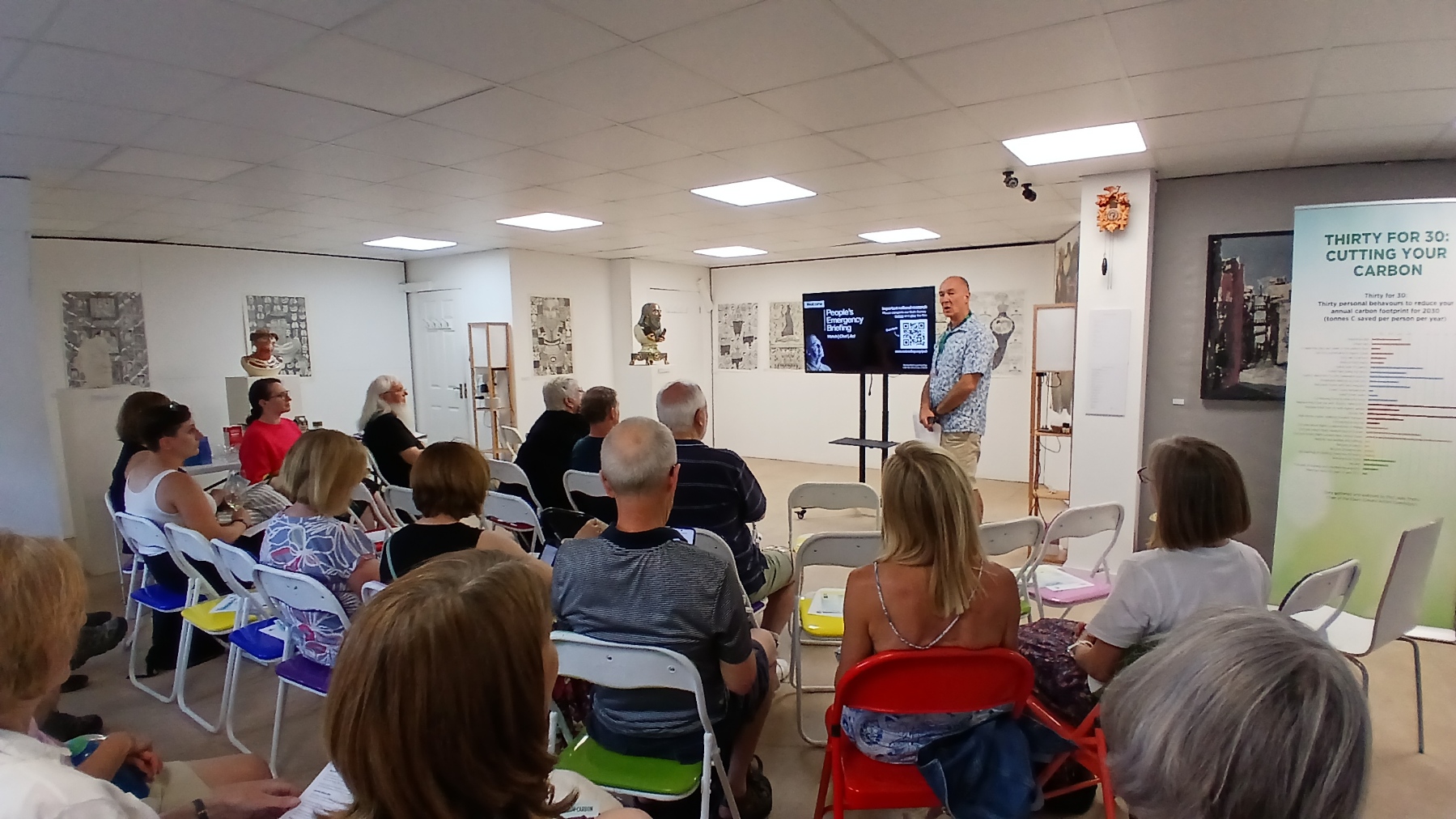
On Friday 19th June 2026, Brentwood Climate Action opened its doors to both members and interested parties, to view the screening of the People’s Emergency Briefing. This film featured scientists of many differing disciplines, coming together with evidence and proof that our climate is in severe crises.
The film was presented by Chris Packham, who invariably throughout the different topics being discussed, would turn to a variety of guests who were viewing the film in a studio and then comment on what they had just heard and seen.
The film highlighted nine topics of major concern: Weather, Climate, Tipping Points, Food Security, Health, Nature, Economics and Energy Transitions.
There were many interesting facts revealed throughout the film, many shocking, but also many ideas of how we as a species can do things differently, all we need to do is get the policy makers and the political will into those who govern us.
Also, during the broadcast a lot of myths that most have taken as fact were debunked, these included:
Cost: It would actually save our economy rather than cost it to implement environmental policies discussed in every topic covered by the film and as green technology advances, it will cost even less in the future.
Reclaiming our arable farmland for crops rather than feeding the meat industry. Therefore consuming a plant rich diet will have the added knock-on effect of tackling the obesity crises and our health as a nation would be greatly improved.
Another area of concern are our declining numbers of insect pollinators of which arable farming is totally dependent on. We need to focus on returning our country into a species rich environment, of which we will all benefit from.
Flooding, a direct result of climate change, is now irreversible, so we have to deal with how we tackle it. However, there are cities and towns who have developed new technological infrastructure which basically act like sponges, located deep underground the buildings and streets. Even now, there are many task force trained workers, scientists, engineers, etc ready and waiting to take vital jobs and posts within the renewables and green infrastructure industries.
It has also been shown that 85% of our population want some serious solutions to addressing climate issues, but the government is not supporting what the majority of the public are calling for.
The film ended with a call for action that we can all be a part of:
1 Spread the word
2 Join others near you for community projects
3 Put pressure on the government eg lobbying
4 Address and hold to account the imbalance between Oil Companies and the environment
5 Call for NEB to be shown across all TV networks.
To finish, the filmmakers expressly require the group to discuss the topics raised in the film, which is indeed what we did, after the viewing.
There were two main reactions that presented themselves from our audience with the following comments:
Firstly there was a strong sense of Hopelessness, including:
We’re walking into Armageddon.
The saddened quote said by one of the scientists taken from the film, telling his young son, “at least I tried…”
Also, with added sense of inequality: We are governed by huge corporations more so than parliament, and: Giant oil companies can put huge finances into lobbying.
Followed by: We feel our individual voices are not represented in government.
And from those who have tried: Constantly feeling the strong tide of political push back.
And ending with poor political decisions: The Labour Government shelved the ‘National Security Climate Report’, and the ill-thought policy: Disappointing that our government has Climate and Environment as a separate department rather than it be covered as a part of every department and be incorporated as the emergency that it is.
However, as the evening wore on the mood did change to reveal some very Positive arguments including:
More domestic use of green energy and having a sense of empowerment to try other forms of renewables.
To engage with and support local ideas and initiatives, e.g. wild urban spaces projects, the solar farm proposed for Shenfield, to name just a couple.
To realise the power of positive lobbying, which is no less powerful and just as important as negative lobbying; showing your support for initiatives, balancing the negative support with positive support.
Evidence that industry is supporting green technologies as the way forward, with Trade Unions already producing a booklet: ‘Green Jobs’, (please visit https://www.cacctu.org.uk ,courtesy of Steve) for its respective members.
And of course, having firm evidence that it can be achieved:-
China, over a short period of time, has halved its C02 emissions – we may not agree with China’s political landscape but for this area they have proved to the world that it can be done.
There were also many comments about the film itself:
Many found the film personable and likeable in its approach.
Several comments were made about finding it more helpful to view with a group rather than if it was viewed alone. Others said that it presented many ideas for solutions, but some felt that they didn’t think they were all do-able.
This film has now been screened and viewed by over 2,500 small groups/organisations across the UK and even by some abroad, too.
There was, however, a strong feeling felt by many, that the film missed out a lot of topics that they felt could have been addressed e.g. aviation and shipping in particular.
A special thank you to Jonathan and Jacqueline for hosting tonight’s film screening. A big thank you to all who took part and especially Cllr David Worsfold, who was able to explain a lot of the machinations of our local council. Also, a big thank you goes to Prof. Jules Pretty OBE and his work in compiling the ‘Thirty for 30’ leaflets: one for reducing Carbon emissions and the other for Nature Recovery, which when used as a tool, give us all hope for the future, in these very uncertain times.
The BCA were thrilled to have as our guest speaker Professor Jules Pretty, OBE. Jules Pretty is Emeritus Professor of Environment and Society at the University of Essex. He is an award-winning author, writing about nature, climate and people, creating stories about transformations that lead to action and change. He is Chair of the Essex Climate Action Commission and President of Essex Wildlife Trust.
Jules presented his talk:
Story for Climate and Nature Recovery
‘Climate and nature recovery starts to happen when we’re able to turn anxiety to agency’
The nature of story-telling is at the heart of Jules’ message. It is an age-old means of passing detailed information from one generation to the next and story as a form is far older than any ancient written language. Story carries with it moral tales, traditions and history, reinventing itself through the course of time.
Synopsis: The pattern for our own story to tell, around the needs of the climate crisis we face, follows the same distinct pattern of all story telling however ancient. So, how do we tell our story? We speak to those around us. Negativity with the subject will only breed hopelessness and lethargy. We must, therefore, present positives that lead to action (agency), by presenting ideas of the ‘little things’ people can do. Who then could a) pass on to others and, or b) try a second, third or other ways of doing something positive, whereby each difference has a positive outcome for that individual e.g. saving money, healthier diet, exercise etc.
Jules used a metaphor, whilst stating, that this is the first time humanity has been caught in a very dark and very ‘deep hole’, driven deeper by an undercurrent of political selfishness and profits over people, which was spearheaded by the Thatcher years and has continued, becoming more imbedded within our society. Our economy too, is run on a ‘scarcity’ model, promoting public anger and negative outcries about situations that have been literally manufactured e.g. cost of living crisis, etc. However, there are positives: green technologies and imaginative ideas,concepts and inventions have been springing up of which we can all be apart of, especially if we all come together and act as one.
To finish, Jules presented all who were there with two flyers: both titled ‘Thirty for 30’. The first one is ‘Thirty Actions for Nature Recovery by 2030’ and the second, ‘Thirty for 30: Cutting Your Carbon’.
Jules stated that just starting off small, even choosing just one action, is the first step on a pathway to free ourselves and escape this dark place that we have found ourselves in.
Jules then concluded by saying that if everyone could reduce their carbon footprint to one tonne a year, our planet, ourselves and nature could avoid being stuck down that ‘black hole’ forever.
Jules Pretty is launching his new free podcast in May: ‘Heat, Camera, Action’
We would like to say a BIG THANK YOU to all who performed, to all those behind the scenes and to all who came to witness our biggest and most ambitious event yet and also, to be a part of Earth Day 2026: a worldwide initiative to raise awareness of the realisation that our world – our only world – is so fragile and in deep need of our help.
However, none of this would have even been possible without the vision, courage and dedication of Meryl, our very own BCA chair. So once again, let’s all raise our glasses and say a big thank you to Meryl, to each other and to our beautiful world, the planet Earth.
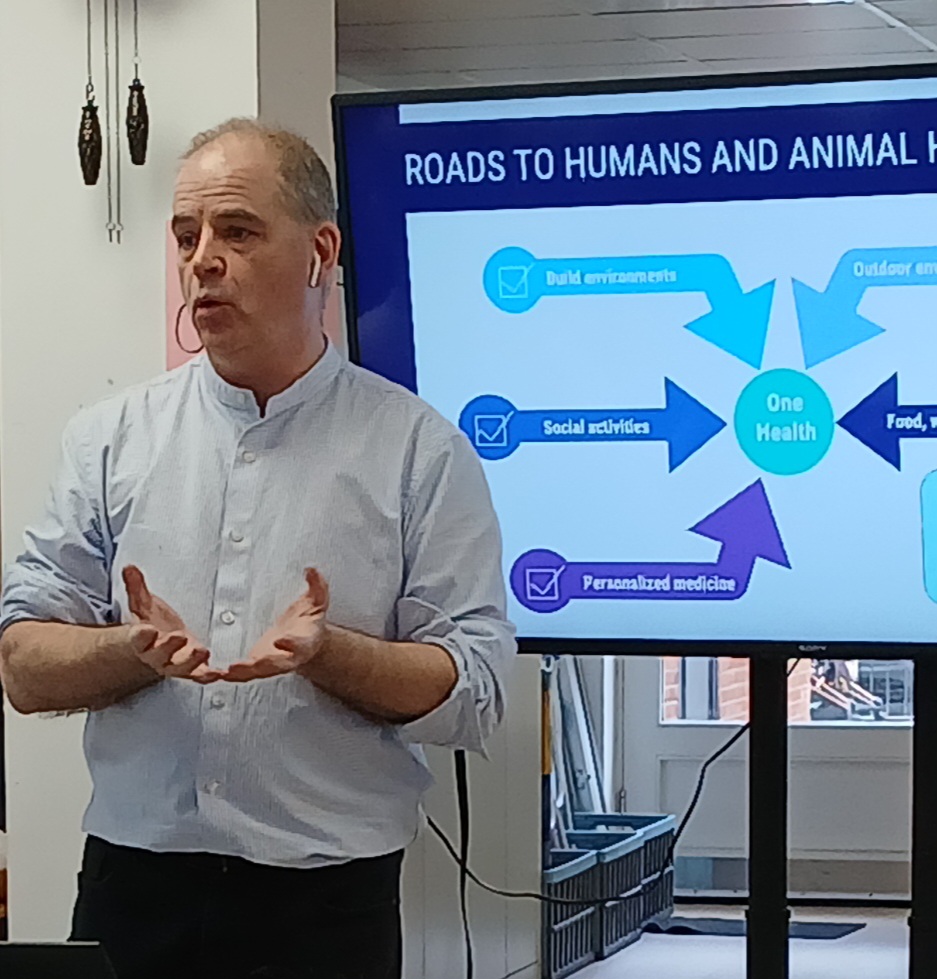
One of our own members, Joe Flanagan, present a talk about the harsh chemicals present in everyday cleaning products.
He talked about all the antibacterial chemical cleaners that have and continue to be sold and marketed in a way that makes us believe that these very strong ‘chemicals’, (“kills 99% of bacteria”) do exactly as they say on the bottle. Joe also added than within the cleaning industry, these products are simply referred to as ‘chemical cleaners’.
Joe’s argument, proven by scientific research, suggests that by using these harsh cleaners they are only destroying the weaker strains of harmful becteria whilst causing the stronger bacteria to mutate and become more and more resistant, therefore more harmful.
Joe then presented his product: cleaners using probiotic technology. Probiotics are bacteria in themselves but play a very beneficial part in the general ecology, or, in other words, they are known as ‘friendly bacteria’. His formular involves a natural probiotic, which, whilst contained within the spray bottle, etc., is inactive until used for cleaning. He explained that once the probiotic bacteria had a source of food (debris, spillages, etc.) they then feed on this, but most crucially, they also feed on the harmful bacteria, being their natural predators.
Joe, to prove his point, cited the real-world situation within hospital wards, where harsh chemical cleaners are routinely used. A direct link has been made between the most cleaned and scrubbed areas of the wards and the highest incidences of harmful bacterial pathogens infecting inpatients.
Joe has created a line of probiotic cleaners which he sells to the public via his website.
Joe’s talk concluded with a lively debate around the topic, followed by an informal chat and general discussion.