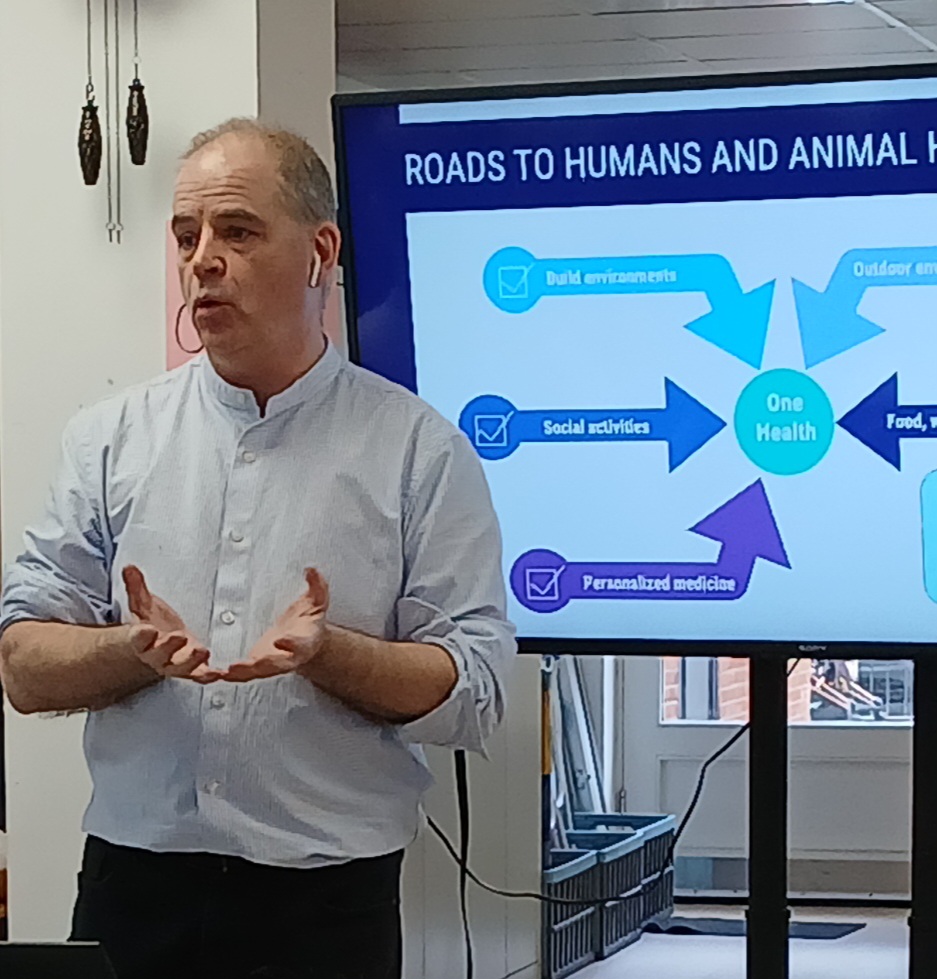
One of our own members, Joe Flanagan, present a talk about the harsh chemicals present in everyday cleaning products.
He talked about all the antibacterial chemical cleaners that have and continue to be sold and marketed in a way that makes us believe that these very strong ‘chemicals’, (“kills 99% of bacteria”) do exactly as they say on the bottle. Joe also added than within the cleaning industry, these products are simply referred to as ‘chemical cleaners’.
Joe’s argument, proven by scientific research, suggests that by using these harsh cleaners they are only destroying the weaker strains of harmful becteria whilst causing the stronger bacteria to mutate and become more and more resistant, therefore more harmful.
Joe then presented his product: cleaners using probiotic technology. Probiotics are bacteria in themselves but play a very beneficial part in the general ecology, or, in other words, they are known as ‘friendly bacteria’. His formular involves a natural probiotic, which, whilst contained within the spray bottle, etc., is inactive until used for cleaning. He explained that once the probiotic bacteria had a source of food (debris, spillages, etc.) they then feed on this, but most crucially, they also feed on the harmful bacteria, being their natural predators.
Joe, to prove his point, cited the real-world situation within hospital wards, where harsh chemical cleaners are routinely used. A direct link has been made between the most cleaned and scrubbed areas of the wards and the highest incidences of harmful bacterial pathogens infecting inpatients.
Joe has created a line of probiotic cleaners which he sells to the public via his website.
Joe’s talk concluded with a lively debate around the topic, followed by an informal chat and general discussion.